Tools & Gear
The Complete Grooming
Tools Buyer's Guide (2026)
The pet supply market is flooded with grooming tools that all claim to be essential. This guide cuts through the noise — explaining what each category of tool actually does, which specific tools are worth the money, and where budget options perform just as well as professional gear.
9
Tool Categories
6
Shampoo Types
2026
Updated
Tool Categories: What You Actually Need
The grooming tool market is enormous, and walking into a pet supply store or browsing online without a plan leads to purchasing redundant tools, the wrong tools for your dog's coat type, or expensive equipment that sits unused. Before buying anything, understand which category of tool solves which problem.
Brushes and combs handle the pre-bath preparation and post-dry finishing. They remove loose hair, prevent matting, and distribute natural oils through the coat. The right brush depends entirely on your dog's coat type — a slicker brush that works beautifully on a Poodle is nearly useless on a Labrador's short dense coat.
Clippers and blade attachments handle length reduction and shaping on coats that grow continuously. Not every dog needs clippers — short-coated and double-coated dogs are never clipped. Curly, wavy, and wire coats that grow indefinitely do require periodic clipping.
Scissors handle detail work, face trimming, feet tidying, and breed-specific shaped trims that clippers can't execute cleanly. Even if you don't do full scissor trims, a pair of blunt-tipped safety scissors for face and paw work is a practical addition to any home kit.
Nail tools prevent the health problems caused by overgrown nails. Every dog owner needs some form of nail tool regardless of coat type.
Bath supplies include shampoo, conditioner, and ear cleaning solution. Choosing the right shampoo for your dog's coat and skin type matters more than most owners realize.
The minimum viable home grooming kit for most dogs: one appropriate brush, a metal greyhound comb, a set of nail clippers, a bottle of dog shampoo, and ear cleaning solution. Everything else builds from there based on your dog's specific needs.
Slicker Brushes: How They Work and When to Use Them
A slicker brush has a rectangular or oval head set with dozens of fine, bent wire pins mounted in a flexible rubber pad. The bent angle of the pins allows them to reach into the coat, catch loose and dead hair, and pull it to the surface for removal. The flexible pad conforms to the contours of the dog's body, maintaining consistent contact across curved surfaces.
Pin spacing is the most important variable when selecting a slicker brush. Brushes with pins set closely together (fine) work best on silky, fine-textured coats — Yorkies, Maltese, and Afghan Hounds benefit from a fine-pin slicker. Brushes with wider pin spacing (medium to coarse) penetrate dense and curly coats more effectively — Poodles, Bichons, and Doodle-type coats need wider spacing to prevent the brush from skimming the surface.
The self-cleaning slicker brush — which has a button that retracts the pins to release collected hair — is a legitimate convenience upgrade worth paying for if you brush your dog frequently. Manually cleaning a standard slicker requires running a comb through the pins to dislodge accumulated hair after each session.
Use a slicker brush after initial detangling with a comb, and after bathing while blow drying. Running a slicker through a dry, matted coat without prior combing will break hair and cause pain. Always follow slicker brushing with a metal comb pass to confirm you've reached the skin.
When not to use a slicker brush: on very short coats (the pins scratch without benefit), on severely matted coats (address mats first with a comb and detangler), and on sensitive areas like the face (use a soft bristle brush or your fingers instead).
Shop the tools
Slickers we actually use
Budget to pro — both remove undercoat when you line-brush to the skin.
Brush
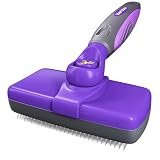
Hertzko Self-Cleaning Slicker Brush
An excellent entry-level brush that's easy to clean. Great for removing loose fur and detangling shorter coats.
Brush

Chris Christensen Big G Slicker Brush
The gold standard for poodles and doodles. Features long pins that penetrate deep into dense coats to remove tangles and fluff the hair.
Metal Combs: Why the Greyhound Comb Is Essential
The greyhound comb — a long, narrow metal comb with teeth on both ends, typically with wider spacing on one end and closer spacing on the other — is the single most useful tool in professional grooming and is chronically underused by home groomers. It does something no brush can do: it confirms that the coat has been brushed all the way to the skin.
After brushing any section of coat, run the greyhound comb through the same area with the teeth pointing toward the skin. If the comb moves through without resistance, the coat is genuinely tangle-free from root to tip. If it snags, there is a mat or undercoat accumulation at skin level that the brush skimmed over. Return to the slicker brush, then comb again. A coat that passes the comb test is a coat that won't mat before the next grooming session.
The wide-tooth end of the greyhound comb is used for initial detangling on longer coats and for working through wet coat after bathing. The fine-tooth end is used for finishing — running through the coat after blow drying to check for any remaining tangles and to separate and define the individual hairs.
Greyhound combs are also the correct tool for combing out dog beards, ear feathering, and leg furnishings — areas where precision matters and a brush is too imprecise. For working through a mustache or beard on a Schnauzer, the fine-tooth end of a greyhound comb is ideal.
Budget note: a quality greyhound comb costs between $10 and $25 and will last for years. This is one tool category where there is no reason to spend more than $25 — the professional grade and budget grade combs are nearly identical in construction. Buy one with stainless steel teeth that won't rust.
Undercoat Rakes and Deshedding Tools: Mars Coat King vs FURminator
Dogs with heavy double coats — Huskies, Samoyeds, Golden Retrievers, German Shepherds, Corgis, Bernese Mountain Dogs — shed enormous volumes of undercoat, particularly during their twice-yearly seasonal blows. Standard slicker brushes and pin brushes move through the guard hair layer without significantly engaging the dense, cottony undercoat underneath. Undercoat-specific tools address this directly.
The undercoat rake looks like a wide-toothed comb with long, slightly hooked metal teeth. The long teeth penetrate the guard hair and reach the undercoat layer, where the hooked tips grab and pull loose undercoat to the surface. Used in the direction of hair growth with moderate pressure, an undercoat rake removes dramatic volumes of loose undercoat in a single session. It is the entry-level recommendation for managing shedding and costs between $10 and $30.
The Mars Coat King is a stripping comb — a specialized tool with multiple serrated blades set in a wooden handle. It was originally designed for thinning and texturizing wiry terrier coats through a technique called carding, but it has become extremely popular as an undercoat removal tool for heavy-shedding breeds. The serrated blades catch and cut loose undercoat rather than just pulling it. The result is excellent undercoat reduction with less work per stroke than a standard rake. The Coat King comes in multiple blade counts — higher numbers mean finer, closer-spaced blades for finer coats; lower numbers mean wider-spaced blades for coarser coats. A 20-blade is a good starting point for most double-coated breeds.
The FURminator is the best-known consumer deshedding tool and is sold in nearly every pet supply store. It uses a fine stainless steel edge that combs through the coat and grabs loose undercoat. For dogs with relatively short double coats (Labrador Retrievers, Beagles, Boxers), the FURminator is effective and easy to use. Its limitation is that the fine edge can scratch skin or cause coat damage called furminatoritis — broken guard hairs — when used with too much pressure or too frequently on the same area. Use it with a light touch and no more than once per week.
The practical recommendation for heavy-shedding breeds: an undercoat rake for routine maintenance, a Mars Coat King for managing a heavy seasonal shed, and a FURminator only if your dog's coat is short and the above tools don't reach the undercoat effectively.
Shop the tools
Deshedding tools that reach the undercoat
Rake for routine blowouts; FURminator for shorter double coats.
Brush

Mars Coat King Undercoat Rake
The ultimate tool for double-coated breeds. Strips dead undercoat without damaging the guard hairs.
Brush

FURminator Long Hair deShedding Tool for Dogs
The professional-grade deshedding tool that reaches deep beneath the long topcoat to safely remove loose undercoat without cutting or damaging the guard hairs. Reduces shedding up to 90% with regular use. Essential for heavy seasonal shedders like Collies, Golden Retrievers, and Maine Coons.
Clippers: Home vs Professional Grade, and Blade Sizes Explained
Dog clippers are rotary or pivot motor tools with a detachable blade that cuts the coat to a specific length. They are only needed for coats that grow continuously — curly, wavy, and wire coats primarily. Short coats and double coats are never clipped (with the exception of sanitary areas).
Home-grade clippers (Wahl Arco, Oster A5 Turbo, entry-level Andis) are designed for occasional use on a single dog. They have less powerful motors that can bog down in thick or matted coats, generate more heat during extended use, and typically come with a single blade and a set of plastic comb attachments that control length. For a small to medium dog groomed every six to eight weeks, a quality home-grade clipper will perform adequately.
Professional-grade clippers (Andis ProClip, Oster Golden A5, Wahl KM10) have higher-torque motors that maintain consistent speed through dense and thick coats without bogging. They run cooler over extended sessions, have a larger selection of compatible blades, and are built to withstand daily commercial use over years. For a large dog, a dog with a heavy coat, or an owner who intends to groom multiple dogs, professional-grade clippers are worth the investment.
Blade sizes follow a counterintuitive numbering convention: higher blade numbers cut shorter, not longer. A #10 blade leaves approximately 1/16 inch of coat — used for sanitary areas, paw pads, and under clipper attachment combs. A #7 blade leaves approximately 1/8 inch — used for body work on Poodles and Doodles in a puppy trim. A #5 blade leaves approximately 1/4 inch — useful for longer body work. A #4 blade leaves approximately 3/8 inch. A #3 blade leaves approximately 1/2 inch — good for a longer, fluffy finish. Blades #40 and #30 cut extremely short and are used primarily for surgical prep, sensitive areas, and between the paw pads.
Plastic blade guard attachments (sometimes called snap-on combs or attachment combs) fit over a #10 or #30 blade and extend the cutting length in half-inch increments from about 1/2 inch to 1 inch or more. These are how most home groomers achieve the longer, uniform body length cuts seen in puppy trims and teddy bear cuts without investing in a full set of blades.
Clipper maintenance matters: clean clipper blades with blade wash or clipper spray after each use and oil them before each use. Blades heat up during clipping — check blade temperature by touching it to the inside of your wrist every few minutes. If it's uncomfortably warm, switch to a spare blade or spray the blade with clipper coolant spray.
Shop the tools
Clippers worth buying once
Cool-running detachable-blade clippers for curly and continuously growing coats.
Tool
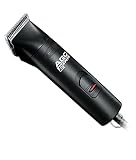
Andis UltraEdge Super 2-Speed Detachable Blade Clipper
Professional grade clippers that stay cool. Perfect for full body grooms and thick coats.
Scissors: Straight, Curved, and Thinning — When Each Is Used
Grooming scissors (also called shears) fall into three functional categories, each designed for a specific purpose. Using the wrong type of scissor for a task produces mediocre results even with good technique.
Straight shears are the general-purpose scissor used for trimming length and creating straight lines — trimming the feet, cutting the leg furnishings to length, shaping the body outline, and scissoring the topline. They range from 5.5 inches (ideal for face and paw work, gives better control in tight spaces) to 10 inches (faster for long body work on large dogs). For home grooming, a 7-inch straight shear covers most situations well.
Curved shears have a blade that bends along its length, allowing the groomer to shape curved and rounded areas — the head, the rear angulation, the transition between body and legs — without creating straight-edged flat spots. The Bichon Frise's spherical head, the Poodle's rounded topknot, and the rounded feet on many sporting breeds are all executed with curved shears. For home groomers attempting a rounded finish on any dog, a 7-inch curved shear is invaluable.
Thinning shears (also called blending shears or chunkers) have one solid blade and one serrated blade with evenly spaced teeth. With each cut, the serrated blade removes only a portion of the hairs in the path of the scissor, which removes bulk without creating a hard line. They are used to blend clipper lines into scissored areas, to soften harsh transitions, and to reduce volume in thick areas without shortening the overall length visibly. Thinning shears are also useful for desensitizing nervous dogs to scissors — the sound is the same but the chance of creating a visible mistake is minimal.
Quality matters more with scissors than with most grooming tools. Cheap scissors have soft metal that dulls quickly, uneven blade tension, and rough edges that fold rather than cut hair. Folded hair causes split ends and an irregular, flyaway finish. A mid-grade scissor from a reputable brand (Kenchii, Geib, Jatai) in the $40 to $100 range will outperform a $20 set so significantly that it's a false economy to start with the cheap option.
Nail Clippers vs Grinders: Pros and Cons
Nail clippers (also called trimmers) make a single cut through the nail, removing length quickly and cleanly. They come in two styles: guillotine clippers insert the nail through a hole and a single blade slides across to cut; scissor-style clippers approach the nail from both sides and cut like pliers. Most professional groomers prefer scissor-style for medium and large dogs because they provide more directional control — you can adjust the angle of the cut more easily than with a guillotine clipper.
Nail clippers are faster than grinders — a complete nail trim on a cooperative dog takes two to three minutes. The cut surface is flat and slightly rough. For dogs that tolerate nail trimming without significant resistance, clippers are the most efficient choice.
Nail grinders (rotary files) use a small abrasive drum that rotates at high speed to gradually sand down the nail. They produce a smooth, rounded finish rather than the flat cut surface that clippers leave. Grinders are particularly useful for dogs with brittle nails that split when clipped, and they allow extremely precise length control in very small increments — making them preferable when working near a difficult-to-locate quick in dark nails.
The drawbacks of grinders: they are slower (four to six minutes for a full trim versus two to three with clippers), they generate heat and vibration that some dogs strongly dislike, they produce nail dust that can irritate airways (work in a ventilated area), and they make a continuous noise that takes some dogs time to accept.
The practical recommendation for most home groomers: scissor-style nail clippers as the primary tool, with a grinder available for finishing — a few passes with the grinder after clipping smooths the rough cut edge and is much faster than using the grinder alone for length reduction. Keep styptic powder within reach regardless of which tool you use.
Shampoos: Tearless, Whitening, Deshedding, Hypoallergenic — What Each Does
Dog shampoo formulations are not interchangeable, and selecting the right one for your dog's coat and skin type makes a visible difference in the finished coat and in the dog's skin health.
Tearless (or puppy) shampoo uses a gentler surfactant system that doesn't cause stinging if it makes contact with the eyes. It is appropriate for puppies under six months, for washing the face of any dog, and as a gentle everyday shampoo for dogs with normal coats and skin. Tearless doesn't mean weak — quality tearless shampoos clean effectively, they're simply formulated to be eye-safe.
Whitening shampoo contains optical brighteners or mild color-enhancing agents that absorb UV light and re-emit it as blue-white visible light, counteracting the yellowing that occurs in white, cream, and silver coats. Whitening shampoos are also mildly effective at lifting staining from tear tracks, paw licking, and environmental discoloration. They are used primarily on Bichons, White Poodles, Maltese, Samoyeds, and West Highland White Terriers. Avoid using whitening shampoo on colored coats — it can bleach pigmentation with repeated use.
Deshedding shampoo is formulated to loosen the bond between the coat and dead undercoat, making it significantly easier to remove loose hair during bathing and brushing. These shampoos typically include ingredients like omega fatty acids and conditioning agents that penetrate the coat and undercoat. Used before a thorough blow dry and brushing session on a heavy-shedding breed, a deshedding shampoo can dramatically reduce the volume of hair released into your home over the following weeks.
Hypoallergenic shampoo uses a minimal ingredient list with no artificial fragrances, dyes, or known sensitizers. It's appropriate for dogs with environmental allergies, food sensitivities with skin manifestations, or a history of contact dermatitis from grooming products. If your dog has itchy, inflamed, or reactive skin, switch to a hypoallergenic formulation as a first step before pursuing a veterinary dermatology appointment — fragrance is a very common culprit in grooming-related skin reactions.
Medicated shampoo requires a veterinarian's recommendation and often a prescription. Shampoos containing chlorhexidine (antibacterial/antifungal), benzoyl peroxide (degreasing for seborrheic conditions), or salicylic acid (keratinolytic for scaling conditions) serve specific therapeutic purposes. Do not use medicated shampoos without veterinary guidance — they can disrupt the skin barrier or interact with skin conditions in ways that worsen rather than help.
Budget Tier vs Professional Grade: What's Worth It for Home Groomers
Not every tool category has a meaningful quality gap between budget and professional grade. Understanding where to invest and where to save prevents overspending without compromising results.
Worth investing in professional or mid-grade quality: clippers, scissors, and the metal comb. These are precision tools where the difference in manufacturing quality directly affects the result. A professional-grade clipper cuts evenly and quietly; a budget clipper pulls, heats up, and produces an uneven finish. Quality scissors hold an edge longer and cut rather than fold the hair. A well-made metal comb with correctly tempered teeth glides through the coat; a cheap one catches and breaks hair.
Budget options are perfectly adequate for: slicker brushes, undercoat rakes, rubber grooming gloves, nail clippers, and shampoo. A $10 slicker brush and a $40 slicker brush accomplish the same task. An $8 undercoat rake works as well as a $35 one. Nail clipper quality matters in terms of blade sharpness, but a mid-grade scissor clipper in the $15 to $20 range performs comparably to expensive options for home use.
The greyhound comb sits in an interesting middle ground — quality matters (look for stainless steel with correctly spaced, smooth-finished teeth), but the price ceiling for a genuinely excellent comb is about $20. There is no need to spend more than that.
Grooming tables deserve a special mention: a proper grooming table makes the work dramatically easier and safer, but the price range is wide. A basic hydraulic or electric table at $150 to $250 is significantly more stable and comfortable than a folding table with a bath mat, which in turn is far better than the floor. For owners who groom their dog monthly or more frequently, a table is a worthwhile investment. For owners who only brush and do occasional nail trims, a non-slip mat on a sturdy counter works adequately.
The final recommendation: build your kit in order of impact. Start with the metal comb (buy quality), a brush appropriate for your coat type (budget is fine), nail clippers or a grinder, and a good shampoo. If you're clipping at home, invest in a quality clipper and blades — this is where cheap tools consistently disappoint. Add scissors as your confidence and technique develop, starting with a 7-inch straight shear and adding curved and thinning shears later.
Quick Reference
Where to Spend vs Where to Save
$$$
Invest in Quality
- Clippers — motor quality determines results on thick coats
- Scissors — blade steel holds an edge and cuts cleanly
- Metal comb — tempered teeth glide without breaking hair
- Grooming table — safety and stability change the experience
$
Budget Options Work Fine
- Slicker brushes — all accomplish the same task
- Undercoat rakes — simple steel construction, little variation
- Rubber grooming gloves — commodity item
- Nail clippers — mid-grade scissor clippers ($15–20) are excellent
- Shampoo — formulation matters more than brand prestige
Shop the tools
Finish the kit
Nails and shears round out a home station — every coat type needs at least one of these.
Nail Care

Miller's Forge Quality Nail Clipper
Used by professional groomers worldwide. Made of high-quality Italian stainless steel with a heavy-duty spring for clean, sharp cuts.
Shears

Geib Buttercut Stainless Straight Shears 7.5-Inch
Professional-grade straight scissors crafted from Japanese stainless steel with a convex edge for whisper-quiet cutting. The offset handle reduces wrist fatigue during extended grooming sessions. Preferred by groomers working on long-coated dogs for achieving clean, sharp scissor finishes on body work and leg furnishings.
Explore More
Ready to put your tools to work?
Read our step-by-step home grooming guide to learn exactly how to use these tools, or browse our breed library to find coat-specific care advice for your dog.